Most of the people who email us about a winter trip are asking the same two questions in a different order. Is anything open? And will I be miserable? The answers are “more than you’d think” and “only if you plan it like a summer trip.”
This is the plain version of what changes up here once the nights go below freezing, and how to work around it.
What closes
Hickory Ridge, the campground inside Grayson Highlands State Park, goes primitive from November through March. The bathhouse shuts, the water is off, and what’s left is porta-johns. The sites are still there and the park is still open; you just lose the hot shower, which in January is most of the argument for a campground.
The Forest Service campgrounds in the Mount Rogers National Recreation Area are seasonal and close for the winter. Grindstone, the big one on VA-603, is a special case this year: it has been closed for the whole 2026 season for infrastructure replacement, with only a loop left open to tent campers and no water. Don’t plan around it until the Forest Service says it’s back.
Whitetop Mountain Road gets gated when the snow comes. It was closed for hazardous winter weather in December last year and stayed shut into the new year, which took the observation site and the Whitetop trailhead with it. You can still reach Elk Garden on VA-600 most of the winter, but assume the summit road is closed unless you’ve checked.
The upper Virginia Creeper Trail is closed regardless of season while it’s rebuilt after Helene. That one doesn’t come back until spring 2027 — we keep the detail current in our Creeper Trail guide.
What stays open
Grayson Highlands State Park is open year-round. The Massie Gap lot is plowed in normal snow, and the Rhododendron Trail up to the Appalachian Trail is the standard winter route onto the balds — see our Massie Gap guide. Check the park’s alerts after a big storm; the access roads, not the park, are what closes.
The ponies stay out all winter. They grow a coat and they stay on the balds. Winter is honestly the most dramatic time to see them, with rime ice on the grass and nobody else on the ridge. Our pony guide covers where they tend to be.
The Appalachian Trail doesn’t close. The shelters are open, and Thomas Knob in particular gets used by winter section hikers because it’s enclosed on three sides. Mount Rogers is a fine winter walk from Elk Garden if you have traction and a turnaround time.
We’re open. We don’t shut for the season, and the indoor heated shower and indoor toilet run all winter. That’s the part most campgrounds in the area can’t offer from November to March, and it’s the reason most of our cold-season guests book with us.
The honest part about the weather
The balds sit between 4,500 and 5,500 feet with nothing to break the wind. A forecast of 35°F and 25 mph in Marion is a wind chill well below zero on Wilburn Ridge. Ice forms on the rock through Rhododendron Gap before it forms anywhere else, and the north-facing sections hold it for weeks. People get into trouble here not because it’s a hard mountain but because they dressed for the valley.
Three rules that cover most of it:
- Microspikes from December onward. Not optional on the AT between Elk Garden and Massie Gap once there’s been a freeze. Trail runners with no traction are the most common thing we see go wrong.
- A hard turnaround time. Sunset is before 5:30 PM in December. Our trail tools page has a golden-hour calculator with departure times for the local trailheads.
- Leave the ridge if the weather turns. There’s no tree line to hide in. The spruce at Thomas Knob and the woods below Massie Gap are the nearest cover in either direction.
Where to actually sleep
Pick based on how much you want to be in a tent.
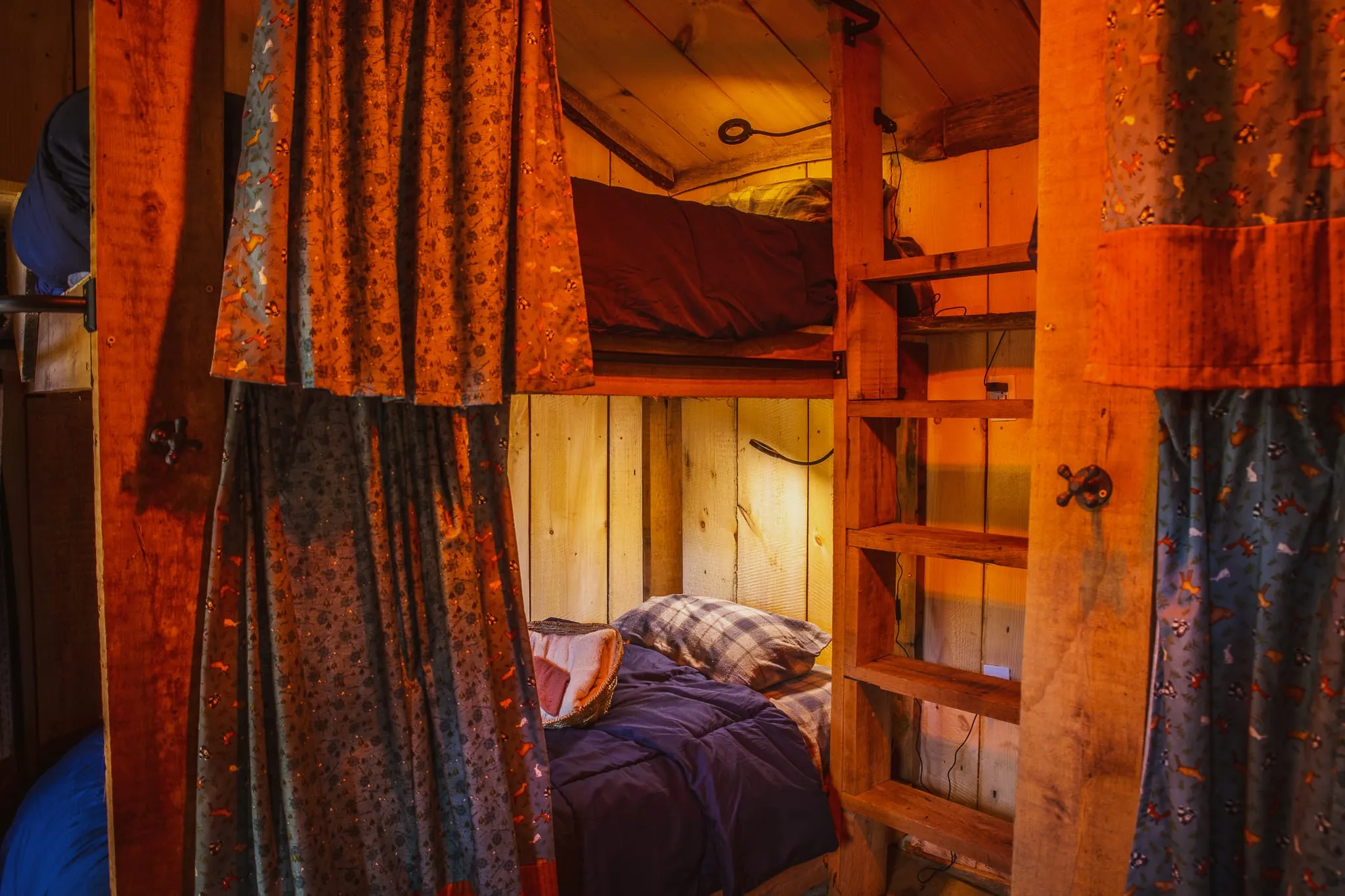
Not at all. The bunkhouse is four beds, heated, booked by the bed. It’s what section hikers use in January, and at $50 a bed it’s cheaper than being cold.
In something with walls. The glamping yurt sleeps four and is the pick for a couple or a family who want the woods without the tent; Jeff is putting a wood stove in it for the season, so ask how it is holding up when you book. It’s also the one that books out first on clear winter weekends.
In your own tent, warm afterwards. Tent sites run year-round at $25 a night. The spring tap stays on, Starlink reaches, and the heated shower is a short walk. Bring a four-season bag; the field sits in a creek valley and it gets colder than the forecast.
In your car. Car camping on the creek bank is the same $25, and in winter it’s underrated — a vehicle out of the wind with a good bag is warmer than most tents.
Hickory Ridge primitive is a real option too if you want to be inside the park and don’t need a shower. Just know that the trade is the shower.
A sample two-day winter trip
Day one. Arrive by early afternoon, drop gear, and walk up to the Massie Gap balds for the last two hours of light. Ponies, rime ice, nobody around. Back for a hot shower and the rec room.
Day two. Shuttle to Elk Garden and walk the AT across the balds to Massie Gap, about eight miles, with Thomas Knob as the lunch stop. We run shuttles to both trailheads, which is what makes the one-way walk possible. Finish at your car, or let us collect you.
If the forecast is bad, swap day two for Cabin Creek trout — the stream fishes in winter on the right day — or the lower Creeper from Damascus.
Before you book
Call ahead if the forecast shows real snow. Highway 58 is kept open, but the last stretch to us is a farm road and we’d rather tell you what it looks like than have you find out. And bring the four-season bag even for the yurt; a stove does most of the work, but a January night at 3,000 feet is a January night.
Book a winter stay or call us with questions about conditions.